Perjury-what me?

The Guardian ran an article by Henry McDonald on 21st August entitled “Stakeknife could face perjury charges , says senior police officer”.

Before you ask, the ‘senior UK police officer’ is not named. Quelle surprise.

So the theory is this. Scappaticci went to court in 2003 to force the NI security minister to state publicly that he was not Stakeknife and therefore not an agent.

Now, says McDonald, he could be prosecuted for going to court and “denying he was a spy”.

But hold on a minute. He denied that he was a spy and the NI minister confirmed that.

So who would be prosecuted?

The NI minister who wrongly said he was not a spy, when he was? Or Scap who falsely said that he wasn’t when he was?

So would one or both be prosecuted? Lets look at the legislation

The Perjury (Northern Ireland) Order 1979

Perjury

  1. – (1) Any person lawfully sworn as a witness or as an interpreter in a judicial proceeding who wilfully makes a statement material in that proceeding, which he knows to be false, or does not believe to be true, shall be guilty of perjury, and shall, on conviction on indictment, be liable to imprisonment for a term not exceeding seven years, or to a fine, or to both.

(2) The expression “judicial proceeding” includes a proceeding before any court, tribunal, or person having by law power to hear, receive, and examine evidence on oath.

(3) Where a statement made for the purposes of a judicial proceeding is not made before the tribunal itself, but is made on oath before a person authorised by law to administer an oath to the person who makes the statement, and to record or authenticate the statement, it shall, for the purposes of this Article, be treated as having been made in a judicial proceeding.

(4) A statement made by a person lawfully sworn in Northern Ireland for the purposes of a judicial proceeding-

(a) in another part of Her Majesty’s dominions; or

(b) in a British tribunal lawfully constituted in any place by sea or land outside Her Majesty’s dominions; or

(c) in a tribunal of any foreign state;

shall, for the purposes of this Article, be treated as a statement made in a judicial proceeding in Northern Ireland.

(5) The question whether a statement on which perjury is assigned was material is a question of law to be determined by the court at the trial.


False written statements tendered in evidence
  1. – (1) Any person who in a written statement tendered in evidence in criminal proceedings by virtue of-

(a) section 1 of the Criminal Justice (Miscellaneous Provisions) Act (Northern Ireland) 1968, or

(b) Article 33 of the Magistrates’ Courts (Northern Ireland) Order 1981,

wilfully makes a statement material in those proceedings which he knows to be false, or does not believe to be true, shall be guilty of an offence.

(2) Any person who in a written statement made in Northern Ireland and tendered in evidence in the Republic of Ireland in any criminal proceedings wilfully makes a statement material in those proceedings which he knows to be false, or does not believe to be true, shall be guilty of an offence.

(3) A person guilty of an offence under paragraph (1) or (2) shall be liable on conviction on indictment to imprisonment for a term not exceeding two years, or to a fine, or to both.

(4) This Article is without prejudice to Article 3, and paragraph (1) applies whether the written statement is made in Northern Ireland, Great Britain or the Republic of Ireland


Aiders, abettors, suborners, etc.

  1. – (1) Any person who aids, abets, counsels, procures, or suborns another-person to commit an offence against this Order shall be liable to be proceeded against, indicted, tried and punished as if he were a principal offender.

(2) Any person who incites another person to commit an offence against this Order shall be guilty of an offence and liable on conviction on indictment to imprisonment for a term not exceeding two years, or to a fine, or to both.

Corroboration
  1. A person shall not be liable to be convicted of any offence against this Order, or of any offence declared by any other enactment to be perjury or subornation of perjury, or to be punishable as perjury or subornation of perjury, solely upon the evidence of one witness as to the falsity of any statement alleged to be false.


So it seems that the Minister could be prosecuted for falsely stating in judicial proceedings that he was not a spy and that Scap could be prosecuted for falsely making the same claim. In addition her civil servants and members of MI5, Special Branch, the Army or MI6 could also be prosecuted.

Sadly , the response of Jon Boutcher, if accurately reported, leaves a great deal to be desired.

The devil is in the detail of Article 14. At least two witnesses are needed for the Crown to prove perjury. Who will they be?

Answers please….?

Meanwhile one has to ask who sponsored the Guardian article- dark forces, Henry?
 

Loughinisland, the strange case of K

Who is person K, referred to in the PONI report ?

His family live between Clough and Dundrum. He is related to Delbert Watson who was convicted of the murder of Jack Kielty in Dundrum in January 1988. Also convicted of that murder were David Curlett and William Bell, the driver of the getaway car. Doreen Watson, whose husband had been murdered by the IRA , sister of Delbert , was convicted of manslaughter.

K , according to Maguire, is a heavily traced terrorist. He has been linked to a conspiracy to murder Peter McCarthy  and the attempted murder of John Henry Smyth. He is alleged to have been involved in the murder of Peter McCormack in Kilcoo on 19 November 1992.

Police told Maguire that he was part of a UVF unit.

Dear Reader, you might pause here to wonder, if the RUC Special Branch, inter alia , was involved in collusion with terrorists, why it would divulge this information to the PONI. I leave that with you.

K and others were identified by Special Branch  to the Loughinisland MIT on the morning after the murders, as potential suspects.

K was arrested and interviewed several times on 18 July 1994. He provided an alibi for the time of the shootings. He said that he was in the Clough Inn with his girlfriend.

This alibi was not properly investigated, says Maguire . It is hard to see what the police could have done , two years later, to establish the truth of the alibi.

Maguire makes a mistake when he says at paragraph 7.169 that K’s hair sample was obtained and found to be a ‘microscopic match ‘ to a hair recovered from a holdall. The bag had not been found at this point.

The holdall was  not found until  4 August 1994. A hair found therein was examined and K was arrested again on 22 August  and the match was made. Caution should be exercised re hair matching after the FBI scandal regarding the science of hair matching.

However, police had a holdall in which they had found, inter alia,  the hair and some overalls. The overalls showed a link with the seats of a Triumph Acclaim car found in a field and bearing a resemblance to the getaway car. Close by was found the VZ58 rifle which was the murder weapon. Fibres from the rifle matched fibres recovered from the Triumph Acclaim.

It is tolerably clear that the Acclaim was the getaway car.

Also, found on a roadway , was a blanket. It has not been properly examined.

I do not know if K has a criminal record, or other matters which might be used as bad character.

I do not know if the hair provided DNA evidence to link K to the bag.

In any event, it is hard to understand why K has not been charged in connection with the murders.

Maguire provides no explanation.

Additionally he makes no case that K was in any way protected, especially by Special Branch. If there was “collusion” as widely defined by Maguire , one might have expected Special Branch to have with held information in respect of K. Instead, the morning after the murders, they tell the MIT about K. K is , one might have thought, a prime suspect.

Maguire makes no criticism of the rigour of the initial investigation.

What is always absent from these reports is the general context.

Viewed as a homicide in leafy Surrey, I’m sure there are points to be made. Northern Ireland was a different environment, with the police overwhelmed by terrorist  crime.

But the question remains.

Who is K and is he a State agent?

That, more than grandstanding by Maguire , would be a fact that the relatives of Loughinisland would prefer to know.


Loughinisland, behind the hype

The Police Ombudsman produced a 157 page report. It wasn’t until page 85 that he got around to the police investigation.

After a detailed discussion, his conclusions were that there were “fundamental failings” in the investigation. He believes that persons A,M,K,I and B , whose names  were given to the investigating team  as suspects by Special Branch the day following the murders, should have been immediately arrested, because there was “strong circumstantial evidence”. That would have made for interesting interviewing. “Well, suspect K, we think you were responsible for the murders, because Special Branch  say so”. One can imagine K’s response , the attitude of his solicitor and the view of the custody sergeant. Dr Maguire’s case is that there was a “compelling intelligence picture”, which demanded their arrests. This is , of course, the stuff of fantasy. No SIO would have authorised arrests in those circumstances.

He next states that when the suspects were ‘belatedly arrested’ , there was a failure to properly examine one person’s alibi , K , an inconsistent approach to the collection of forensic samples and an inadequate investigation into the ownership of the Triumph Acclaim , which he asserts was “used by those responsible for the murders”.

Lets consider the evidence in the case. Neither person who entered the bar could be identified because they were masked. There was nothing found in the bar to connect any person to the shooting, despite rigorous forensic examination of the scene.

The getaway car has been described as a red Triumph Acclaim or Honda Accord. No VRM was reported. A red Triumph Acclaim was found the following morning at Listooder Road. Nothing in the car provided any evidential opportunities and there was nothing to connect it to the murder scene. There is criticism that the surrounding area should have been examined for foot prints and that the foot wear of suspects might have matched soil samples from the scene. Those two points are well made, except that , again, who would have been arrested  and what would the basis for the arrest have been?

The investigation into the possession of the suspect car at the material time was badly handled. Its movements were never adequately traced.

A blanket found on a road has not been fully examined.

So, in the immediate aftermath of the murders, the SIO had no evidence to arrest any person for the murders. Even if person O,P,Q, R or S had been suspected of possession of the car, where would that have led, given the usual negative response in interview?

A subsequent find, in August 1994  of a bag containing clothing provided strong supporting evidence that the boiler suits had been in contact with the front passenger seat and the rear seat of the Acclaim. K’s hair sample was a microscopic match with a hair recovered from the holdall. It is not clear what happened to that evidence, although hair matching has been recently questioned as a forensic tool. K’s alibi was not properly tested.

The VZ 58 rifle was not found until August 1994 , separately from the bag. It can be demonstrated that it was the murder weapon.  The rifle cannot be connected to any suspect. It could be connected to the Acclaim.

Let us now assume that K was the best suspect and that he was arrested. In interview police would have asked him about his movements and challenged his alibi. They would have pointed to the hair match. It is not clear whether or not any DNA was available. Let’s assume it was. The police case, working backwards would be that his hair  and DNA was found in a bag, along with overalls, which could be linked to the seats of the Acclaim which might have been the getaway car. The murder weapon was found close by and can be connected to the Acclaim. K remains silent, as is his right. That’s the height of the case.

Would that provide a reasonable prospect of success for a prosecution for murder?

Finally, Dr Maguire accepts that the investigation “categorised in excess of one hundred people as suspects”. Make of that what you will, Dear Reader.


Twenty seven years ago

On this day, twenty seven years ago , the PIRA bomb team, which I have publicly named, [ all of whom are still alive, some active in the SF/IRA election campaign in North Belfast] killed my father and so wounded my mother that she died the next day.

Let’s focus on  my mother, Ellen Sefton, aged 66, retired. Her only connection to “the conflict ” as SF/IRA now call it, was to be married to my father and to be a Protestant. No words of apology were ever uttered  by PIRA about her  death. She was the subject of a sectarian assassination involving collusion by the State, no different to those killings suggested by republicans. In all the forty years I knew her she never uttered a word against Roman Catholics. She was ahead of her time. She  befriended gays and Jews and loved the  heady atmosphere of New York. She loved its words and its freedom. She loved her family. She looked after  her mother till she died at 92.  She was full of life. She was my biggest fan. Perhaps that’s why it hurts so much.

Twenty seven years on , the State campaign of ‘forgive and forget’ is still being waged. Useful young idiots , solicitors, businessmen etc. are tapped up with promises of places on NGOs, slap up dinners, and photographs with the great and the good; if only they would embrace the “Peace Process”. The hurt and damage that these people cause  is beyond measure.

For all of these 27 years the State has lied to me, about the big stuff, its involvement  with PIRA, with Libya -and about the little stuff, who knew what about  UCBTs. The State knows who killed my parents, why would they not? They had so many informers that  by 1990 they had over run PIRA. So why don’t they come clean? What dead hand prevents disclosure? Who protects the like of Sean Maguire? To what end?

Who could believe the British Government about any security issue, old or current? A lesson that many of us have learned and many of the relatives of  the dead of Manchester and London will soon learn. Nothing is ever as it seems and the State will always lie to you.

I miss my parents every day.

I’ll continue to fight for them till my dying breath. It has cost me every material thing  I owned  but that doesn’t matter.

If I don’t do it , who will?

And I still own myself….

Gripping the IRA :Part II

It is useful to set out the correspondence in extenso.  [Lawyers love Latin, no more so than Lord Carswell,  that Old Instonian, whose surprising expenses claims for attendance at the House of Lords were set out in extenso in the Sunday Times.]

But I digress.

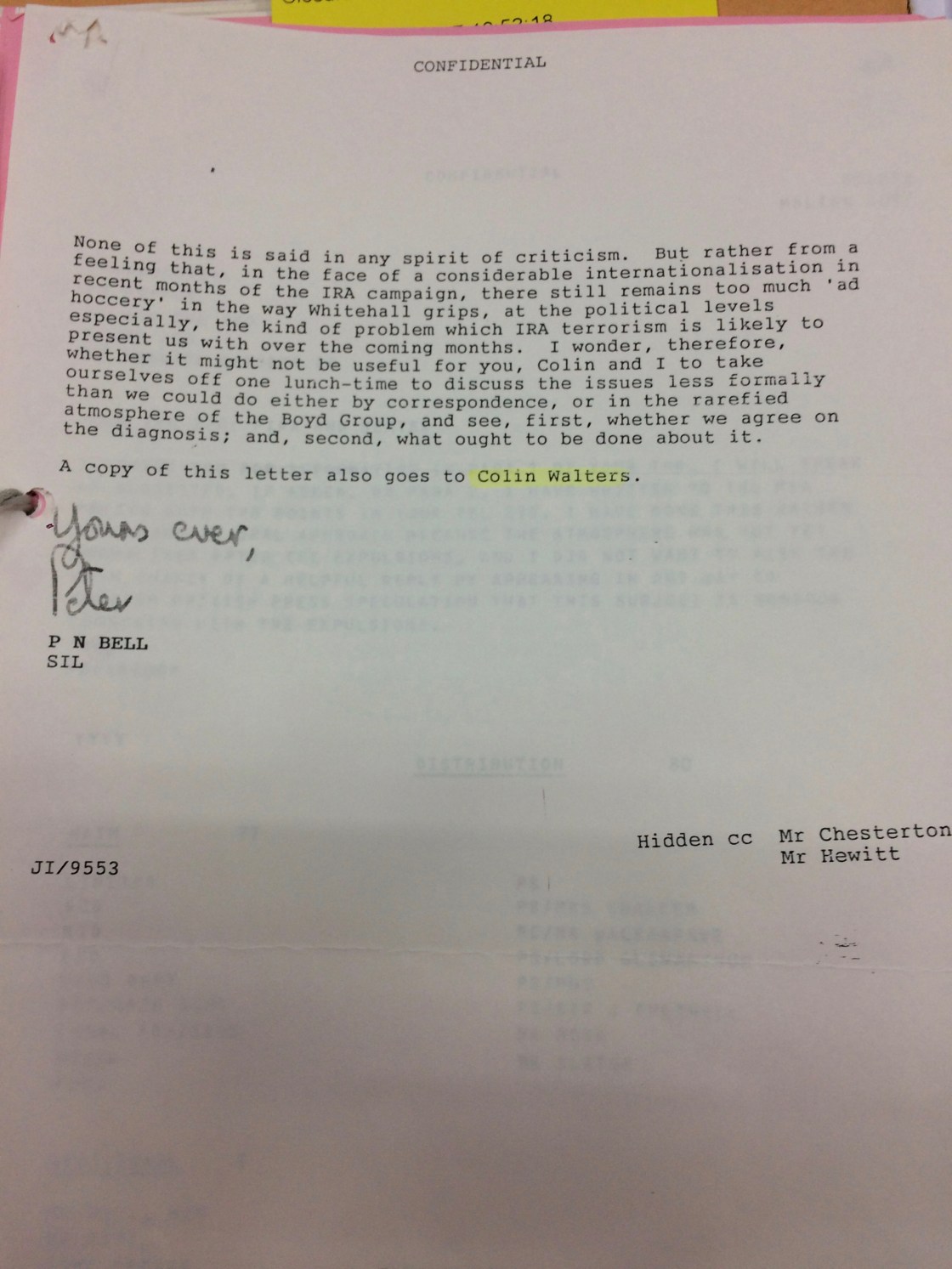
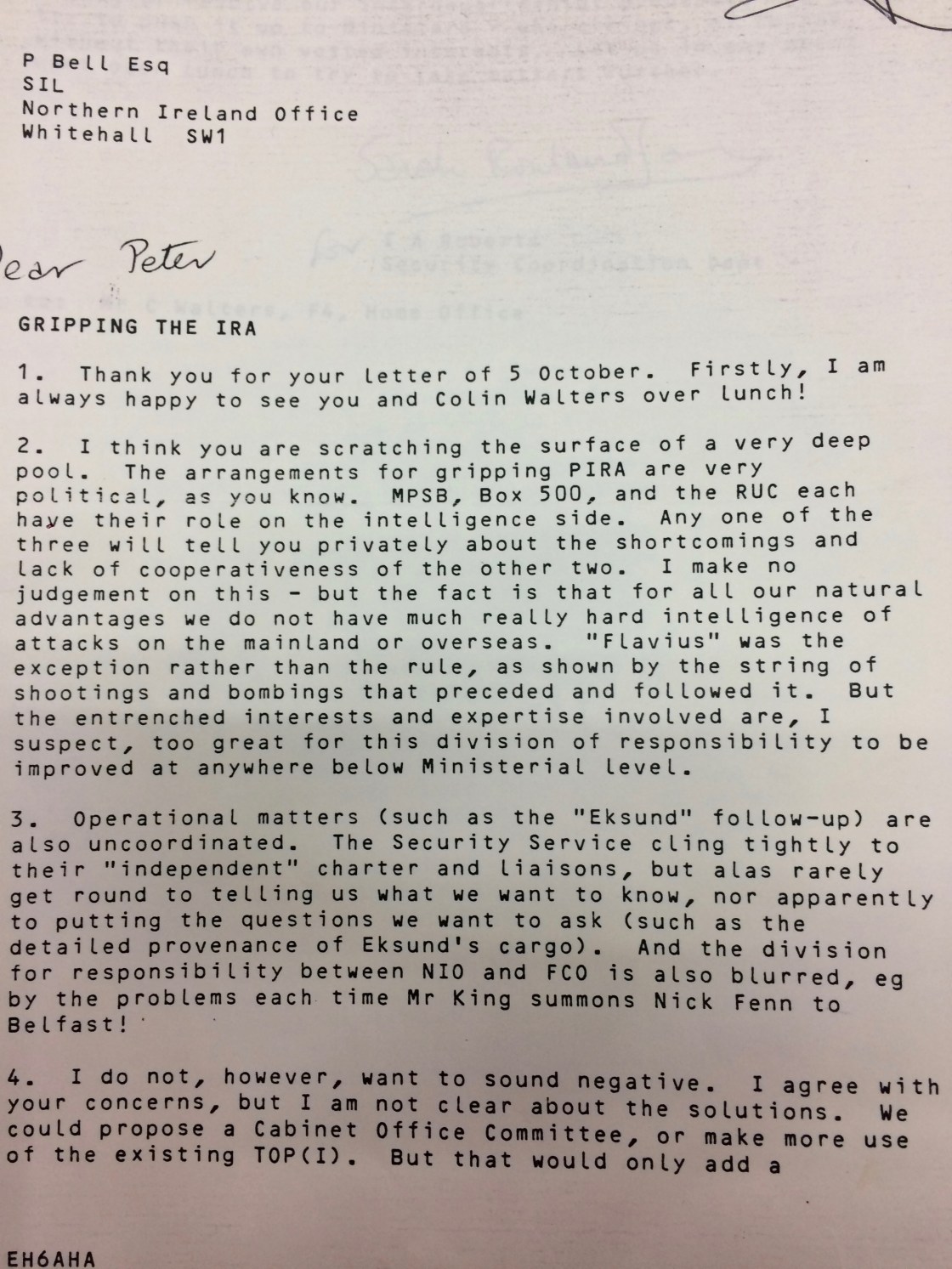
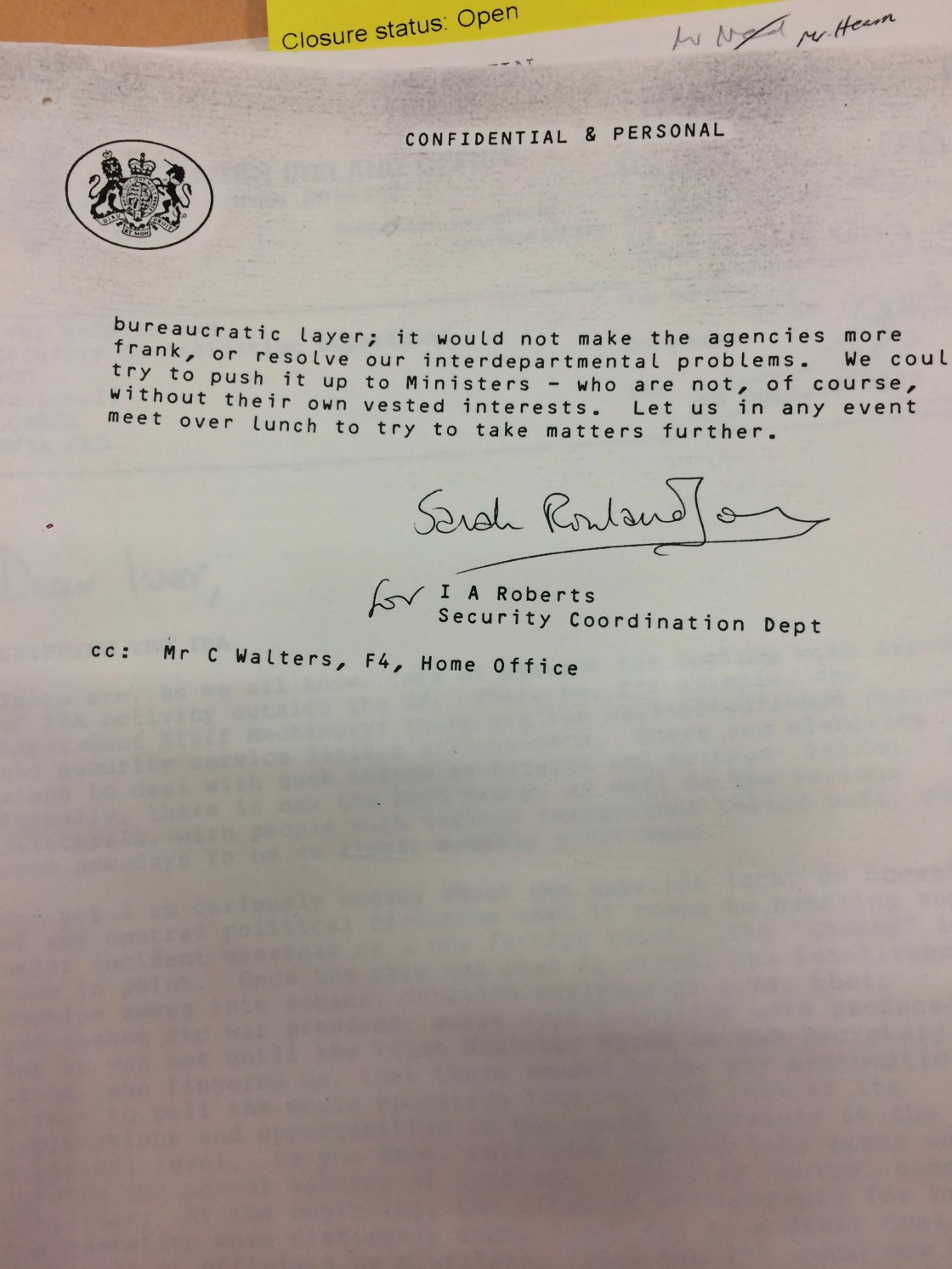
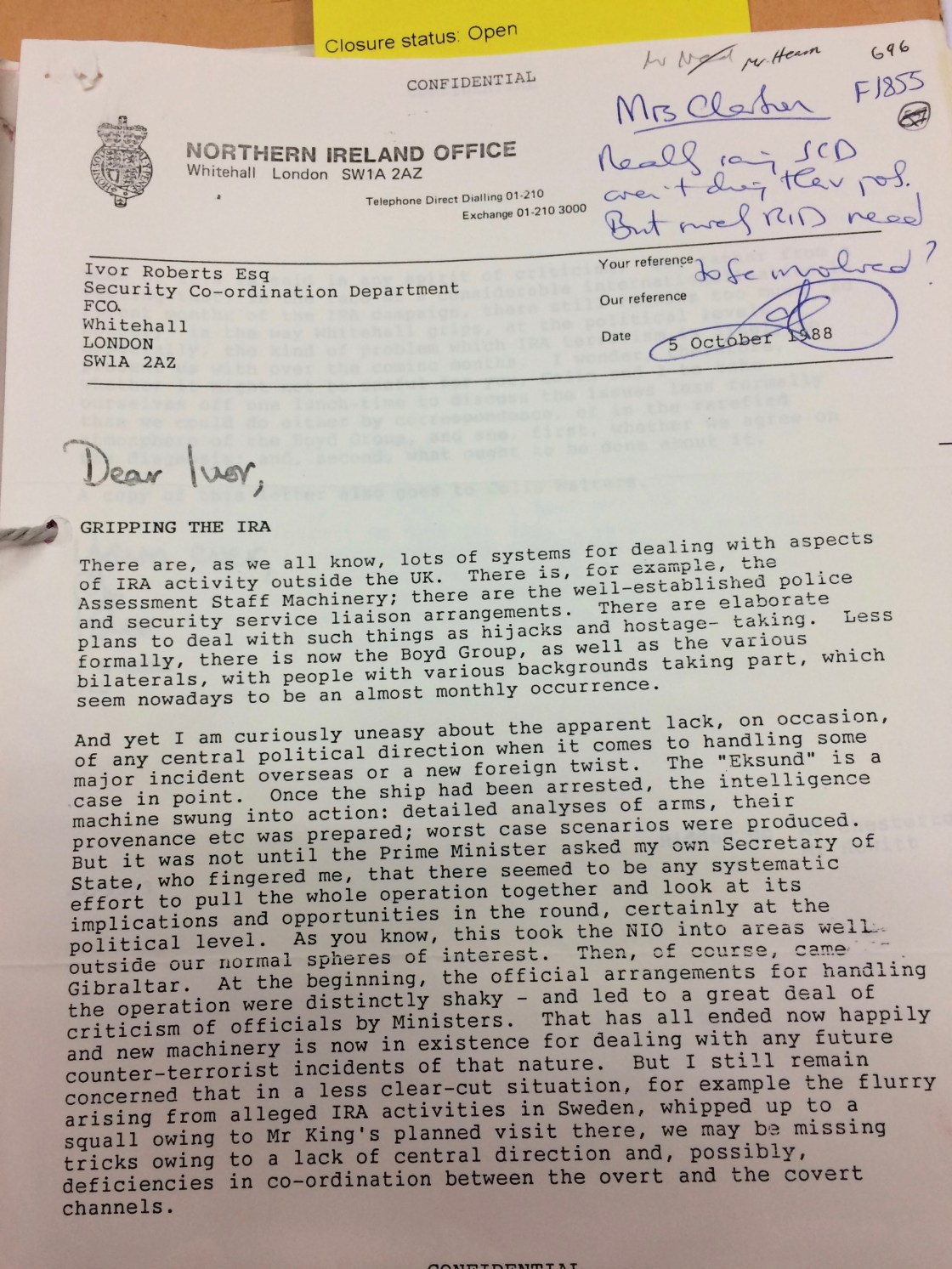
Here is the correspondence.

IMG_3486

fullsizeoutput_266bVersion 2IMG_3485What is surprising about this exchange , coming in late 1988, is the pessimism shown by Peter Bell.

Note his comment “there still remains too much adhoccery in the way Whitehall grips…the kind of problem which IRA terrorism is likely to present us with over the coming months”.

Ivor Roberts has no firm proposals, in reply, except for a jolly good lunch. [Your club or mine?]

The exchange does not sit well with the analysis by those who say that by this point PIRA was heavily infiltrated and was being paralysed.

It does, however , point to the likelihood that each of the agencies, RUC , Box and Army , were very much doing their own thing with informers. That leads on to the question whether or not the RUC, with a duty to preserve life, could ever have known if informers to the Army and Box were participating in murder.

Re the Boyd Group, TOP [I] and the Assessment Staff Machinery, that is all for another day, Dear Reader.

“Gripping the IRA”

Much has been said about the security triumph which, the Brits say, halted the IRA and led to the Good Friday agreement.

In  late 1988  a different picture was being painted by the Security Coordination Department of the Foreign Office. In a letter to the Northern Ireland Office , Ivor  Roberts said that “MPSB, Box 500 and the RUC each have their role on the intelligence side”.  He remarked  that Operation Flavius was the exception rather than the rule and that operational matters such as the Eksund follow up are also “uncoordinated”. He said that the Security Service ” rarely get round to telling us what we want to know”.

Operation Flavius was the shooting of three IRA members in Gibraltar. Roberts complained that nobody would tell him of the detailed provenance of the Eksund’s cargo. On the latter point, the cargo came from Libya but it is very likely that the Secret Intelligence Service and possibly the Security Service had agents among those who purchased the arms  and particularly the Semtex in Libya. This may well explain the reluctance of HMG to press for compensation for those killed and injured by PIRA Semtex bombs.

There were also issues between the Foreign Office and security coordination.

He characterised the position as “entrenched interests”.

He had no solution to propose, reflecting that the responsible ministers “are not, of course without their own vested interests.”

The image is of each party, RUC, Army and MI5 ploughing its own furrow, to the detriment of security. It gives further credence, of course, to the case that many killings and other operations were carried out by one arm of the State, unknown to another. Collusion by the State was not directed just against Republicans.

The play wot I wrote

Here is a teaser from my latest play:

Detective Constable Gault is talking to Flora, the love of his life and describing what life was like in the RUC….

“Do you know that in my time in the force I saw forty dead bodies? Old dears, dead for days and not a fucking relative came near them. Just like a small dead dog in a nightie. One small child, cot death. What do you say to the parents? Some of my mates thought children were the worst deaths. Car crashes, motor bikers. Going to the wife’s door to tell her. Screaming, falling on the floor. Vomit, trying to get her GP. Suicides, mostly pills. Do you know I once found a man who had hanged himself by jumping off a bridge on the way to the shipyard? He was swinging on the end of a rope, his lunch box was still tucked under his arm. Bomb deaths. Some without a mark on them. Others mangled. Others in bits. You had to get big see through plastic bags for the parts. Like going to the wholesale butchers. You’d generally no idea how many bodies you were dealing with. Gunshot deaths. Wee hole on the forehead, big mess at the back. Seeing a dead mate was the worst. Davy, blown apart in the yard at Grosvenor Road. I’d just passed him when the mortar exploded. Could have been me, ten seconds earlier. I was shot up five times. Escaped without a scratch. Took the dead and wounded to the Royal, then back to the station, de-brief then a bottle of whiskey. That was health and safety and care for the employee. No shrinks, no nurses, no counselling, except the Super came and told us we were great. If the worst came to the worst, you got sleeping tablets. Oh and I got a medal from an ACC and the whole force got the George Cross. Never shot and killed anybody. I did try…. Flora laughs quietly at that. WILLIAM GAULT (CONT’D) Worst time was the hunger strikes. We were on duty for twelve hours without rest. Eating and pissing when we got a chance. Keeping the squaddies out of trouble. Meals in a tin. The squaddies loved ours, Her Majesty’s Meals Ready to Eat were shite. I couldn’t eat ours either. I had ten tins of chicken curry in the garage for years. FLORA CAIRNS Why did none of you complain? WILLIAM GAULT About the food? Flora laughs and throws a small cushion at him. FLORA CAIRNS No, you eejit, your stress! WILLIAM GAULT Nobody knew that it was dangerous, at least the rank and file didn’t. You just got pissed after an incident, you were driven home and you came back the next day. Then there were the young cons, who burned the candle at both ends. Fast cars and faster women. Guy with us, came off duty at five, drove his XR3i to Enniskillen to see his girlfriend. Wine , curry and sex. Back in the car at five AM to go on duty at seven. The old hands couldn’t do that so it was the sports club on a Saturday with the missus but the result was the same, blotto. FLORA CAIRNS Hard for any wife to take. WILLIAM GAULT Very. ”

Steven, if you read my blog, I’ll sell you the rights on condition that Jamie Doran is not cast.

The Crumlin Road Canteen

In the series “Life on Mars’ the boss calls a meeting. The shock is that his colleagues are smoking, drinking, , eating pies and generally behaving in a way that nobody under 55 could remember.

I have read the Police Ombudsman’s report into the Loughinisland killings and , hopefully, I will write about it. But the point which is missed by him is the historical context. It is as if two men went into a pub in leafy Surrey and carried out an atrocity and the local Bobbies, with time on their hands, screwed up.

Let me describe the Crumlin Road courthouse in the 1980s. I do this  for two reasons. First , because, as a matter of policy, anyone associated with prosecuting for the Crown in those days has been erased from history as part of the deal with SF/IRA and secondly to explain what life was really like.

As one approached the courthouse from the city direction, there was frequently a RUC or army road stop. Only the bold prosecutor approached from the Ardoyne direction. This I did occasionally. More frequently I drove my GTI Golf at 90 mph down the M2 and then came up from the city centre.

At the entrance to the courthouse there was a security team who wanted to inspect your car, including boot and engine compartment.

This team was covered both from the open ground and from the heavily armed sangar.

Once inside the grounds, a further check might be carried out.

The Director of Public Prosecutions had its offices on the top floor of the building. Not a problem when one is fit.

More important was the canteen, to be found on the left hand side of the ground floor. Here was a microcosm of the Troubles. It was a small room, a counter at the far end and a number of tables. Behind the counter Etta presided. She had been at school with my Dad. She and her staff produced a wide array of food. From the black coffee and a possible scone for the barrister to the fry for the constable.

Why is this story important?

Because each morning the fug in that room had to be seen to be believed. There was no ban on smoking. Officers who had been out all night on duty and who were now required to attend court to give evidence in a terrorist trial , were trying to dry off their uniforms while having a fag and an fry. Later they would try to get home for a few hours sleep before another spell of duty.

Sometimes it was hard to see across the room. I recall chatting to colleges about how nice it would be to get away to the Med. One said, “isn’t it great to walk down to the local shop and buy croissants and yesterday’s paper and come back and read them in the sun?” Another described how beads of water ran down the outside of a bottle of white wine, placed on your table.

That was just escapism. On a day when the great and the good have joined together to mark the first day of the Somme, it is important that we do not wait one hundred years to mark what ordinary men did to protect society in Northern Ireland.

As , Dear Reader, you judge the acts and omissions of policemen and lawyers and read the Police Ombudsman’s report, prepared at length, in a non smoking environment, reflect on what life was really like and how the Crumlin Road canteen, shared with police officers, prosecutors, witnesses, paramilitaries ,Patrick Finucane, Paddy McGrory, Oliver Kelly and Seamus Tracey was a microcosm of how the troubles was really played  out.


A victim

Much is said about victims. We have a Commissioner for them. She has an office and staff. This costs us about £1,000,000 each year. I have never sought help from them. Why, I hear you say Dear Reader, am I blogging about this, especially on an Ulster summer day? For this reason. Occasionally in the battle for compensation from Libya, a battle won for their citizens by the USA, Italy,France and Germany but disgracefully lost by Perfidious Albion.I have found myself writing about “victims” as if I am one. Also, more than one person has said “you’re forever portraying yourself as a victim”. So I’ve decided to think about what I am. To begin. Not a day goes by when I don’t think about my parents. I’m sure I’m not alone in that. I’m a citizen of the United Kingdom. That gives me rights and responsibilities. I contend that the murders of my parents didn’t take place in a vacuum. They happened when the State had so penetrated the terrorists and so perverted justice that not only did one arm know who killed my parents but at a meeting on the Shankill Road another arm, the RUC , gave the UDA a name and the UFF set out to kill him the night my mother died. He was Sean Keenan, a well known Republican from Riverdale Park South. He survived, as he did when he was shot in 1984, along with Adams. So perhaps I am a vengeful angry citizen. I represented the Crown in court for twenty five years. How many times did the state deceive me and the court? But wait! In some respects I am a victim and I shouldn’t shy away. I’m a victim of people who should have been at my parents’ funeral and weren’t, I’m thinking of a particular grandson. I’m a victim of a spouse whose only solution was to hand me a glass of wine so that she was not bothered by my problems. I’m a victim of the Bar Library which never enquired into my well being for twenty five years until I got into trouble , then briefed Frazer Elliott , that icy cold , presbyterian, paragon of virtue to prosecute me. Not unexpected in that cold house for unionists. I’m a victim of senior police officers who continue to lie to me about what intelligence exists. I’m a victim of the many people who tell me to “get over it” or that it is “a legacy issue” or that “we need to move on”. I’m a victim of those erstwhile friends and colleagues who say “the grief has got to him” and pass by on the other side of the street.I’m a victim of the State which is just passing time until I , and others like me, pass on. So here I stand. A victim. But that is different from victimhood. My daughter criticises me for “not taking responsibility for myself” . An interesting accusation. Instead I’ve taken the responsibility of the fight for justice. I don’t regret that, nor what it has cost me [ my career, my house my family] , nor what the future holds. I can now go several days without seeing or talking to a soul. At the last I hope , though, that some will see me as a son who tried his best for his parents.   Franz Schubert said:” Every night when I go to bed , I hope that I may never wake again and every morning renews my grief.”