Danny Morrison

In December 1988, a telex was sent to Our Man in Brussels.

The subject was Danny Morrison. It was a briefing for the Ambassador.

The writer invited the Ambassador to “draw on the following background on Danny”….

It contained the following information.

“Morrison was interned between 27 November 1972 and 21 December 1973,..he was editor of An Phoblacht [Republican News] in the late 1970s [mouthpiece for IRA and Sinn Fein]…currently director of publicity for Sinn Fein-postion held since early 80s…member of Art Comhairle [Sinn Fein National Executive] for several years…in 1981 he made the infamous quote ballot box /armalite unquote speech at the Ard Fheis [Sinn Fein Annual Conference]…in January 1982 was charged with entering the US illegally and deported to Canada….known to be a quote hawk unquote rather than a quote dove unquote….involved in recent talks with SDLP …vigourous in defending ‘armed struggle’ and publicly   dismissing talk of a ceasefire….”

The author went on “You may also say unattributably that we have good reason to believe that Morrison is heavily involved in a central position on the military side of Sinn Fein’s activities”

In January 1990 Morrison was arrested near a house where Sandy Lynch [Special Branch informer] had been interrogated by Sean Maguire [state informer] and Freddie Scappaticci [state informer].

Morrison’s arrest and subsequent wrongful conviction got him off the streets and away from the centre of power. Was that because he was a “hawk”? If so , “cui bono?” The British? The Sinn Fein/PIRA doves? The “Peace Process”?

Answers on a postcard, Dear Reader.

Oh! I almost forgot. The author of the telex?

“Howe”……


Ike, JFK, and the Gettysburg Address

Chris Mackowski's avatarEmerging Civil War

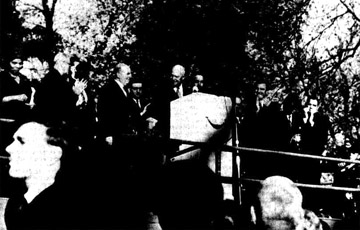
Ike at Gburg Address Centennial.jpg Ike at the lectern for the 100th anniversary of the Gettysburg Address (photo courtesy The Gettysburg Times)

Today is the anniversary of the death of President Dwight D. Eisenhower in 1969. In commemoration, we offer the intertwined story of Ike, JFK, Lincoln, and the Gettysburg Address.

*     *     *

For the 100th anniversary of the Gettysburg Address, the Centennial Commission and National Park Service invited President John F. Kennedy to come to south-central Pennsylvania and offer a few appropriate remarks. Renowned for his writing almost as much as Lincoln was—Kennedy had won the Pulitzer Prize in 1957 and his inaugural address had become an instant classic—the president seemed the ideal choice for such an auspicious occasion. He had also visited the battlefield earlier that year, in March, and had enjoyed himself tremendously.

Kennedy demurred on a return trip, however. He had already committed to attend a…

View original post 965 more words

Thinking About The Irish Brigade At Antietam

Sarah Kay Bierle's avatarEmerging Civil War

Overlooking the Sunken Road and Attack Fields from the observation tower. (Photography by author.)

Today is St. Patrick’s Day, a day many folks find something from Ireland to enjoy. I have two traditions on the unofficial holiday: wear a little green and remember the Irish-American contributions during the Civil War. Last year, I wrote about Irish music in America during the 19th Century. This year I find myself remembering Meagher’s Irish Brigade at Antietam. Looking through my photo files and remembering that humidly hot day at the battlefield, I recalled those thoughts and feelings experienced while walking near the brigade’s battle position.

Overwhelmed. The single word to describe my six hour visit to Antietam National Battlefield. There are times we visit battlefields and historic sites for research or armed with a thousand pages of knowledge. There are other times we arrive at hallowed ground with basic knowledge and the desire…

View original post 636 more words

Gone For A Soldier: Journeys of Irish American Music & Patriotism

Sarah Kay Bierle's avatarEmerging Civil War

Johnny Is Gone for a Soldier. (1862) Sep. Winner, Philadelphia. [Notated Music] Retrieved from the Library of Congress, https://www.loc.gov/item/ihas.200001462. Johnny Is Gone for a Soldier. (1862) Sep. Winner, Philadelphia. [Notated Music] Retrieved from the Library of Congress, https://www.loc.gov/item/ihas.200001462. The journey of Irish songs now woven into the collections of traditional American music represents the journeys of the Irish people and how music and a war intertwined to bring the Irish immigrants into a more positive light in 19th Century America.

The war-song Johnny Has Gone For A Soldier is a hallmark of folk music, and, though usually associated with the American War for Independence, it was also known and sung during the Civil War. The song is closely related the Irish song Shule Agra which is believed to have been created during the 1600’s. At some point in the next century, the English and Americans begged, borrowed, or stole the tune and foundational lyrics to create Johnny Has Gone For A Soldier. On both sides of the…

View original post 1,648 more words

1. So, what’s this “Marine A” malarkey all about then? Marine A, or Sgt Alexander Blackman, today succeeded in his appeal against his conviction for murdering a wounded Taliban insurgent whilst on a tour of Afghanistan in 2011. The Court Martial Appeal Court (CMAC) quashed his conviction for murder and substituted a conviction for manslaughter on the grounds of […]

via The Marine A judgment – a handy 10-point guide — The Secret Barrister

“Gripping the IRA”

Much has been said about the security triumph which, the Brits say, halted the IRA and led to the Good Friday agreement.

In  late 1988  a different picture was being painted by the Security Coordination Department of the Foreign Office. In a letter to the Northern Ireland Office , Ivor  Roberts said that “MPSB, Box 500 and the RUC each have their role on the intelligence side”.  He remarked  that Operation Flavius was the exception rather than the rule and that operational matters such as the Eksund follow up are also “uncoordinated”. He said that the Security Service ” rarely get round to telling us what we want to know”.

Operation Flavius was the shooting of three IRA members in Gibraltar. Roberts complained that nobody would tell him of the detailed provenance of the Eksund’s cargo. On the latter point, the cargo came from Libya but it is very likely that the Secret Intelligence Service and possibly the Security Service had agents among those who purchased the arms  and particularly the Semtex in Libya. This may well explain the reluctance of HMG to press for compensation for those killed and injured by PIRA Semtex bombs.

There were also issues between the Foreign Office and security coordination.

He characterised the position as “entrenched interests”.

He had no solution to propose, reflecting that the responsible ministers “are not, of course without their own vested interests.”

The image is of each party, RUC, Army and MI5 ploughing its own furrow, to the detriment of security. It gives further credence, of course, to the case that many killings and other operations were carried out by one arm of the State, unknown to another. Collusion by the State was not directed just against Republicans.