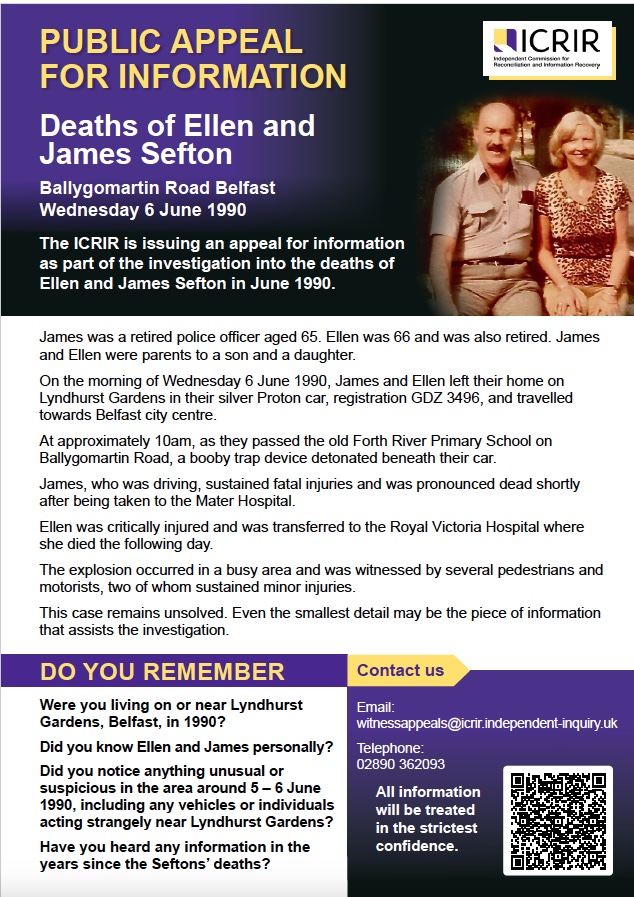
Today, an appeal for information is being made about the killings of James and Ellen Sefton on 6th June 1990.
The poster is attached to this article.
They were our parents.
Today is the 101st anniversary of our Dad’s birth.
This additional appeal is made on behalf of me, and my sister Margaret; not forgetting their grandchildren, Carolyn, Piers, Andrew, and Victoria and their great- grandchildren, Guy and Bryn.
That, in itself might indicate how much time has passed since this atrocity.
In particular, I want to reach out to members of the RUC, the UDR, other regiments of the Army and also the security services.
It is my belief that, whilst the killings were carried out by PIRA, other actors were involved.
Research and ‘open-source material’, including Operation Kenova, shows that almost every terrorist atrocity involved participating informants, that is to say terrorists who were in the pay of the State and who were permitted to commit crimes, including murder, by their handlers.
Some of those directly involved in the killings of James and Ellen may be dead. But the State does not die.
The primary duty of the State is to protect its citizens.
In James’ and Ellen’s case that did not happen.
Out there, still, must be policemen, soldiers and others, whose conscience may be pricked by this determined search for the truth.
The investigation may reveal the names of terrorists and State actors, but it would be helpful if others would get in touch.
As for us, …love goes on.
“for I have promises to keep, and miles to go before I sleep, and miles to go before I sleep…..”
The Police Ombudsman has recently released a report on three killings; that of Henry Babington on 4th October 1989 and those of Constables Beckett and Myer on 30th June 1990.
I am particularly interested in the latter incident, it coming 24 days after the murders of my parents.
Readers of my blog will know that my special interest is the activities [or lack thereof] of senior RUC officers, Special Branch personnel [sometimes described as a force within a force] the Army and the Security Service, in respect of the murders.
Some of the striking features of my parents’ killings were that:
There was no public appeal for witnesses or information, either immediately or at any time,
There was no round-up of suspects, except for a character called Braniff,
There was only a perfunctory search at the scene, missing the magnet,
The fragments of the bomb were disposed of, and
The file was put away in a cupboard months after the murders.
I was interested to see what assessment would be made of the constables’ murders, coming in much the same time frame.
There is an obvious difference , in that their killings took place in broad daylight in the city centre. No matter.
This is what the Ombudsman had to say:
“Having gathered and reviewed substantial documentation, the Police Ombudsman said the RUC investigation was “well resourced, well managed and conducted without any delay.”
It raised 338 investigative actions, recorded over 420 witness statements, and received over 190 messages. These were part of a police investigation that incorporated witness, forensic, intelligence, and suspect enquiries.
The Senior Investigating Officer’s (SIO) policy log, internal reports and briefings demonstrated that he viewed forensics as integral to his investigation and considerable work was done on examining descriptions given of suspects and preparing for arrests.
Initial information following the murders was promptly disseminated and the first arrests were made within hours of the murders. More followed, and there were a significant number of arrests.
However, there was insufficient evidence to charge any of these persons with offences linked to the murders.”
The Ombudsman then moved to consider the interaction between investigators and Special Branch. The underlining is mine.
“Although it is clear from police documentation that the SIO sought all relevant intelligence from Special Branch and that he utilised this intelligence from the day of the murder, the Police Ombudsman has identified failures in the non-dissemination of intelligence by Special Branch.
Intelligence is not evidence but the Police Ombudsman believes that this intelligence could have been capable of supporting new and further lines of the enquiry for the SIO, had he been made aware of them.
That revelation will hardly come as a shock to students of the Troubles killings. My opinion is that informers were protected at all stages of investigations by SB, even if there was a suspicion that they were committing offences well beyond any “agreement” with their handlers. Apologists, like Matchett, and others, refuse to even mention that participating informants existed.
“However, aside from early arrests, the available investigative material showed that where intelligence and information which named individuals allegedly involved in the murders was passed to the RUC investigation team, limited action was taken. This investigation has been unable to establish the reason for this.”
Next comes another old standard. The inexplicable and unexplained lack of activity and curiosity by SIOs. At that point in time, ‘ordinary’ detectives were constrained and controlled by SB. Arrests could not be made without their prior consent, that was a publicly known arrangement but who knows what other ‘informal’ arrangements were in place?
It is difficult to imagine that a succession of SIOs were incompetent, inept, and downright lazy, but perhaps they were?
This, as has been pointed out in relation to my father, was two of their own; compare that to the actions of police forces worldwide when a colleague is killed.
Then comes the most important finding. “The Police Ombudsman considered the absence of action to be significant in one particular instance where information was provided by the military. Members of the military came forward to report that a person had told them that he witnessed the murders and knew the gunmen by name. They also provided a photograph. This did not result in any new lines of enquiry. “
“This information highlighted a person that potentially had very significant information pertaining to the identity of the gunmen. It is not known why the SIO did not generate any enquiries emanating from this intelligence,” said Mrs Anderson.
In any murder inquiry, when the SIO is presented with an eyewitness who knew the gunmen and saw the shooting – that is gold dust. The failure to follow this up is inexplicable, save for what I have written below.
The Police Ombudsman identified further missed investigative opportunities, including inaction after the planned arrest of two people on suspicion of the murders could not take place because the area had been designated out of bounds. The police records of the investigation do not provide a rationale for why there was no further attempt to speak to or arrest these individuals.
“Out of bounds” was a euphemism. It covered a multitude of scenarios. Genuine threats against uniformed officers, on patrol; planned operations, or SB controlling the situation for their own ends.
In view of the available evidence and information, the Police Ombudsman concurs with the concerns of Constable Beckett’s daughter about police failures to pursue evidential opportunities.
“I am of the view that the investigative failings in this case are so significant that it was incapable of leading to the apprehension and prosecution of the perpetrators, and therefore, was not Article 2 compliant,” concluded Mrs Anderson.
In overall conclusion, Mrs Anderson said:
“I am of the view, based on the available intelligence reviewed by Police Ombudsman investigators, that there was no intelligence that, if acted upon, would have been capable of preventing the murders of Henry Babington and Constables Beckett and Meyer.
“I believe that Henry Babington, Constable Beckett and Constable Meyer were the innocent victims of a campaign of terror mounted by republican paramilitaries. PIRA alone was responsible for the murders.”
It may well be that PIRA was “responsible” for the murders. That is not the whole story.
These murders were scouted, planned and as the late Ed Moloney said, were approved at the level of Martin McGuinness. It is inconceivable that one or more informers did not pick up this plan and convey it to their handlers.
Equally, it is borne out by the inexplicable failure of communication and the equally inexplicable indolence by the SIO, that other actors were at work.
Was the person who supplied the identities of the killers well placed to know them? Was he a businessman in the area? Was he well known to police, perhaps as an informant relating to ‘ordinary’ crime? Is that why his intel vanished into thin air?
A failed and flawed investigation into two of their own.
I do not know whether the present Chief Constable will apologise for these failings. Maybe he will say that in 1990, police were overwhelmed. Not something I recall being said at the time.
The smart OxBridge boys and girls in the NIO will chalk this off as another One Day Wonder and get on with the task of governing the colony.
Meanwhile , I and others haven’t finished with the RUC, the PSNI or the Security Service.
My condolences to the families of Henry Babington, Gary Myer and Harold Beckett. And especially to Constable Beckett’s daughter, who has campaigned so tirelessly.
On looking through his papers, recently, for something else, I came across the following piece of paper, which seems to have been found in Jimmy’s locker.
“James
I missed you this morning. I hate to ask but would it be possible to loan me £60. I am sure you will be saying I am making a habit of this, but I assure you I would not ask only I am stuck at the moment.
J…………….[redacted]
I will explain later”
I’ve redacted the author’s name but if he would like to make contact I’d welcome that.
Who knows what happened , but £60 almost forty years ago was not insubstantial and the writer had clearly been helped before.
Did the transaction complete before my dad was murdered by PIRA? I don’t know.
He’ll be sitting in his favourite armchair, still complaining about the inaccuracy of the BBC weather forecast and nestling a glass of whiskey, with which one was greeted in the winter months.
He’ll be reminiscing about his days in the force. How they were once pinned down by a sniper and had to run across a wide street, one-by-one to escape. Or when their lives were saved by an informer who rang in to say there was an ambush ahead.
Or maybe he’ll be talking cars. From the sixties he was a Ford man, turning to the Japanese later and then to his final car, a Proton, from Malaysia. My early choice of a white XR3i was deemed a “young con’s car”. A clean car was essential. “Yours looks like a Provo staff car”.
Or travel. His favourite place was Venice and his favourite bar, Harry’s.
I imagined it to be a flashy emporium. I visited it last year. It sits just off the Grand Canal. Small and unimposing from the outside, it is understated; the waiters are beautifully mannered and impeccably dressed. No shorts or jeans permitted after six. I could see why he liked it so much.
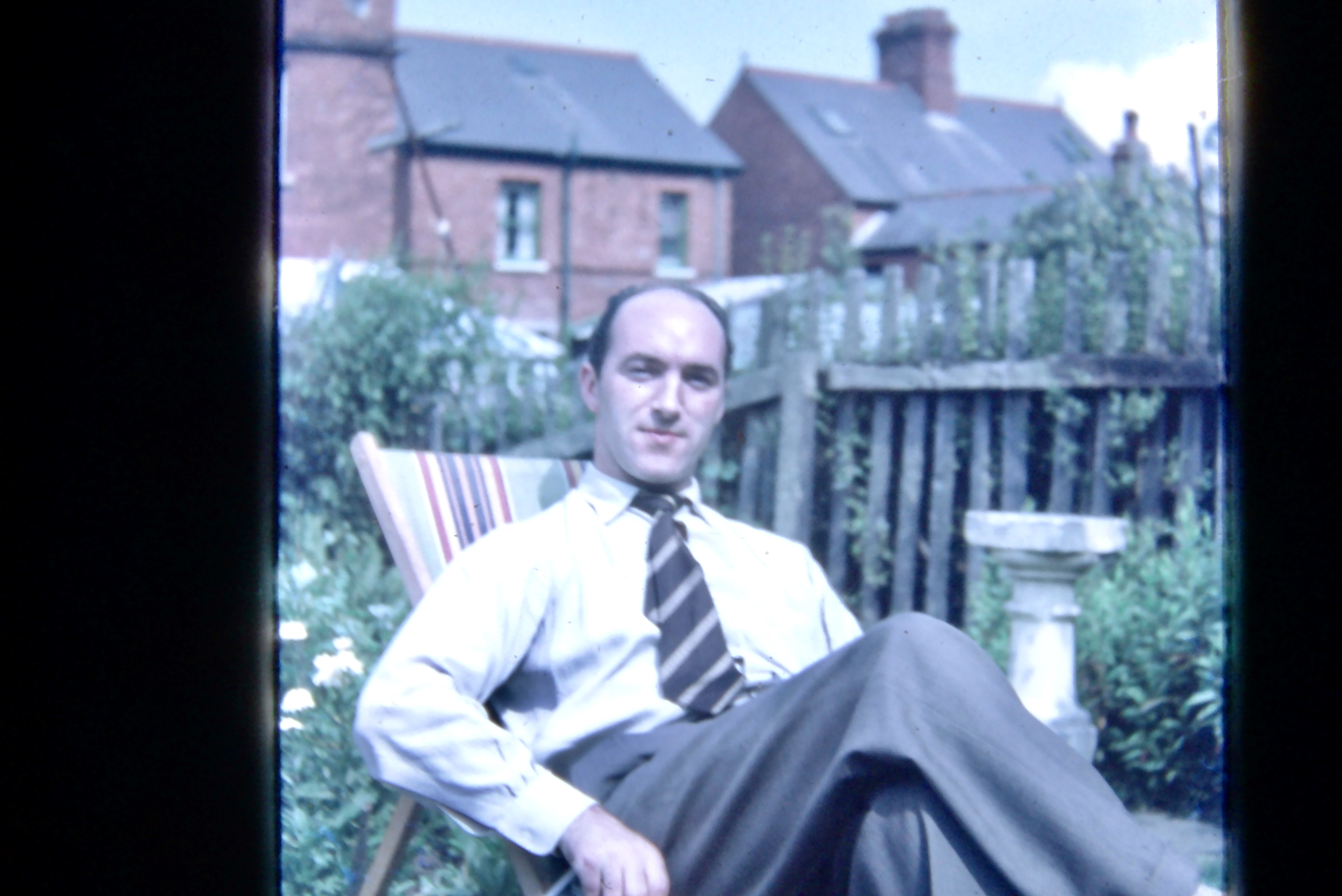
James was born on 25th February 1925 on a cold day with rain turning to sleet; to William and Cissie [nee Annette] both of Huguenot descent. He lived his early years with his parents, brother and sister in a small house off the Shankill road in Belfast.
On his sixteenth birthday he was apprenticed to Harland and Wolff, serving his time and working for many subsequent years in the Engine Works. He later moved to Standard Telephones and Cables as a supervisor, before joining the RUC. He served in the Home Guard while an apprentice and seems to have enjoyed the training, especially the thunder flashes. He made me a beautifully crafted half size Thompson machine gun, which was the envy of my boys’ gang, they equipped with toy shop revolvers. We spent many hours constructing Airfix planes and ships. He was an excellent artist and later turned his talents to photography. I watched as he patiently saved to buy his first 35mm camera, moving on later to a range of Pentax.
Jimmy worked “all God’s hours” in the shipyard, in the “Standard” and in the force. My abiding memory is of him leaving for a night shift during the loyalist protest at the signing of the Anglo-Irish agreement. I expressed concern for his safety, which he dismissed, even when I said I would buy fire extinguishers for the house.
Books were his passion. He read at least three a week, borrowed from the Shankill Road library. When I was eight, he took me there and signed me up. He took me to a shelf in the Children’s section and selected Dicken’s Tale of two Cities. “I think you’ll like this”. I took it home and opened it:
“It was the best of times, it was the worst of times.”
Thus started my love of books and of learning and of libraries, Shankill, Queens and the Bar.
He and my mother were what would be called today ‘aspirational parents’ Though when I got a place at Queens and announced it over breakfast, his response was “anyone who gets a place at university and fails to make the most of it, should be shot”.
A smoker until his forties, his treat at Christmas was a Tom Thumb cigar.
He had a short retirement, frequently travelling to warm places with my mother.
A few days after his death, a postcard from their holiday in Tenerife arrived, it said: “having a beer in the shade, the Germans haven’t the wit to get out of the midday sun”.
To the last, laconic, quiet and universally described by his colleagues as a gentleman.
On 6th June 1990 the Provisional IRA placed a bomb under the car of James Sefton, a RUC officer, retired three years. The subsequent explosion killed him and his wife Ellen. My parents.
I began investigating the circumstances in 2002. I started with the PSNI. I was bounced around between senior officers , including the “salad dodger’ , before finally meeting Chief Inspector Blair, who had evidently drawn the short straw.
He told me that the papers had been stored away. He did not know who had made that decision. Nor when the papers had been stored. He was unable to give me any details about the investigation, if that is the correct word.
In March 2004 ACC Sam Kincaid informed me that the case was being examined by the Serious Crime Review Team. You would be unsurprised, Dear Reader to learn that I never heard a word from this ‘team’ .
I asked the Historical Enquiries Team [lots of sporting analogies] to investigate.
I also made a complaint to the Police Ombudsman.
Each of these organisations told me that they had had access to all intelligence and there was nothing to report.
I had correspondence with Drew Harris, then ACC Crime Operations [was this not a ‘team’?] .
He wrote : “ I can assure you that both the SCRT and the HET had full access to all available information and intelligence material during the course of their respective Reviews … Regrettably, the reviews conducted …did not uncover any new investigative opportunities.”
I sent a detailed reply:
1st September 2014
Dear Mr Harris,
James and Ellen Sefton
Further to your letter of 11th August and my initial reply by email on 20th August, you state in your letter :
“I can assure you that both the SCRT and the HET had full access to all available information and intelligence information during the course of their respective enquiries.”
I would be glad if you would answer the following.
On what do you base this assertion. Is it personal knowledge or are you relying on assurances given by others?
If the latter, who gave you these assurances?
When you use the word “available”, what do you mean? Is it meant to qualify “intelligence”.
Does the use of this word “available” indicate that someone decides to make information available to the investigators and if so, who?
Does the use of the word imply that there is other relevant information which has been withheld?
Dr Laura Lundy, in her paper, Can the past be policed? Lessons from the Historical Enquiries Team Northern Ireland, conducts a critique of , inter alia, the access to intelligence. What can be distilled from her report is the following:
Intelligence was still being found and collated while she was conducting her research. [I note Roy McComb’s late presentation of intelligence to the Smithwick Tribunal ]
“All aspects of intelligence are managed by former RUC and Special Branch (sic) officers”
“It appears that the ‘old guard’ play a key role in the management and access to intelligence and perform a censoring role in respect of disclosure.”
HET relies on the goodwill of partner agencies to cooperate. This would include the security services and Special Branch, now C3.
It appears to me that there could be three types of intelligence that may have been withheld in my parents’ case.
Information held by a partner agency or by the police which points to the person who planted the device or more importantly to those persons who directed and approved the operation.
Information obtained by an informant , either participating or not, pointing to those responsible for directing planning approving or carrying the attack upon my parents.
Similar information acquired by electronic or other means , not involving a CHIS.
For example if Special Branch had decided to withhold information at the time of the murders, it is possible that the same personnel could make the same decision, many years on. Certainly Sir John Hermon had his worries about “the Branch”.
I should be glad;
[a] if you would assure me that no information has come to light since investigations were completed ;and
[b] that no such information as set out above has been withheld from investigators by either the PSNI or any partner agency.
Yours sincerely,
Peter Sefton
Harris did not reply to this but delegated it to Detective Chief Superintendent Hanna, who wrote: “ACC Harris has management responsibility for Serious Crime Review Team and the Historical Enquiries Team, and so his response is based on his personal knowledge that both teams had full access to all available information during the course of their reviews.”
Hanna replied to further correspondence , on 29th October 2014:
“As previously pointed out PSNI have investigated the death of your parents and reviewed the investigation twice since the original investigation, there have been no new evidential opportunities identified”
The case papers were put in a box, again, and that was the last I heard from the PSNI.
For context, Harris was the main man re intelligence and the point of contact for the Security Service until his appointment as Commissioner of AGS.
However on 14th June 1990 a communication was received by the RUC from An Garda Siochana [“AGS”] , by letter [possibly faxed]
The content was that the AGS had received intelligence from a ‘previously reliable source’ that there were threats to three RUC officers.
Namely:
James Stepton [sic]
A N Other
A N Other -serving in Tennent Street station
The source is recorded as stating that he overheard a conversation. He also provided a sketch map, hand drawn, which was communicated AGS-RUC.
I have seen that map , on a laptop computer screen.
An overheard conversation is often a euphemism for being present during the conversation. A handy way for a participating informant to distance himself from the operation.
The informant is likely to be a participating informant.
There was no ‘James Stepton’ on the force and a cursory investigation would have led the investigator to conclude to whom the report was referring.
The hand drawn map is , in many respects, accurate. It is undoubtedly of the Ballygomartin area. It shows the turn of the road from the Woodvale Road to the Ballygomartin Road, Woodvale Park, Woodvale cricket ground, Glencairn park and a number of streets and roads. Although the writing is indistinct on the screen , I am satisfied that it also depicts Lyndhurst Gardens [my family home]and Westway Drive, the street immediately to the east of Lyndhurst Gardens.
The proportions are incorrect but the general ‘get up’ of the map shows a degree of local knowledge , which would not have been gleaned in an overheard conversation.
Most strikingly, there is an ‘X’ , or asterisk , which appears to be in Glencairn park an open area, not a street, which is east of Westway Drive and a line which appears to terminate at the top of Westway Drive.
If the significance of this is the location and then transport of a device, it would involve the navigation of a deep gully , a small stream and a similar climb on the other side, possibly to avoid patrols and Viper.
It seems to me to be a planning document, showing how a bomb could be delivered to my parents’ house, avoiding the main roads.
The information from the AGS was disseminated to the Regional Heads of Special Branch.
One of the other officers who was mentioned in the message served at Tennent Street station and was warned about the threat. So we know that the message was acted upon by SB.
Why did it not form part of an investigation into my parents’ murders?
Why has Harris insisted that there was no intelligence?
I am told by the Operation Kenova team, who turned up this intelligence, that they found it , stored within the RUC/PSNI intelligence systems.
A competent investigation team would have used the intel as a starting point. The reliable informant was telling AGS that he was present [though he distances himself by stating that he overheard it] when an PIRA ASU planned the murders of three police officers. One was actually killed. The planning obviously took place before 6th June 1990, and likely took place in the Republic, possibly in Dundalk. His evidence would support a charge of conspiracy to murder.
The Army/Security Service had a number of informants, including Scapaticci , in place in Dundalk and other places. Was the planning meeting bugged? Who were the planners? Was the AGS informant withholding their identities? Or were their identities known to AGS and withheld from the RUC?
If nobody in the RUC SB, on receipt of the intel said, do we have a James Stepton?- no but we have a James Sefton and he’s dead then they are truly incompetent.
What happened in respect of the third person named I know not.
Harris gave evidence about his role to the Smithwick Tribunal in 2011. He said the following:
“I am responsible for all matters of intelligence, all matters in respect of homicide investigation. At the moment, I am also—have major responsibilities in respect of what’s known as legacy matters., and I would work closely with the historical inquiry team, who are investigating Troubles -related deaths, and they have some 3,260 deaths to investigate.”
Harris was given every opportunity to come clean on what he and others knew. When I said in my letter of 1st September 2014:
“It appears to me that there could be three types of intelligence that may have been withheld in my parents’ case.
Information held by a partner agency or by the police which points to the person who planted the device or more importantly to those persons who directed and approved the operation.
Information obtained by an informant , either participating or not, pointing to those responsible for directing planning approving or carrying the attack upon my parents.
Similar information acquired by electronic or other means , not involving a CHIS.“
Harris was being given a clear opportunity to disclose that information existed.
Aside from his mendaciousness, the new information demonstrates what I have always alleged- that Special Branch cared not, even for their own and that this information, in existence for thirty four years , was known to a number of James’ colleagues, not one of whom disclosed it to me.
Readers of my blog will know that PIRA murdered my parents, James and Ellen Sefton, on 6th June 1990.
I started enquiring into the circumstances in 2002, when it began to dawn on me that all was not as it seemed.
I contacted the PSNI in 2002 who, in terms , told me that the file had been packed away years ago and there was nothing to see. No suspects , no leads, just one of those things….which happened to one of their own…..
I contacted the HET. Same story. ‘We have had access to all intelligence’ there is nothing to see.
I contacted PONI. ‘We have reviewed all intelligence- it has all been made available- nothing to see here’
Then in 2017 I contacted Operation Kenova. I made the pitch that Sean Maguire, now SFIRA director of PR , was involved in the murders and was closely connected to Scappaticci.
This month, after a series of meetings, the Kenova team produced intelligence that had been in possession of the RUC since June 1990.
It raises all sorts of questions as to how the RUC handled intelligence and as to why this intel was suppressed for thirty three years and not acted upon.
It raises issues about cross border cooperation with AGS.
I’m reserving the intel for the moment whilst [hopefully] I receive further and better particulars from Op Kenova, which has been as good as its word about providing victims’ families with new information.
I’ll then be putting the intel into the public domain and inviting you to consider it.
Some time ago I wrote a piece called ‘Money talks’ -you can find it on my blog. Some ex-RUC officers were outraged by it. When you finally see what I know you will have an understanding of how much was suppressed and left undone by James’ colleagues , who went on to have luxurious retirements.
The message to all of you who have lost loved ones in the ‘Troubles’ is simple.
Never give up. The State will always lie to you. The State has no honour. The State has no loyalty. The Judiciary is in the pocket of the State.
Some years ago Geoffrey Miller, a County Court judge, said that I was “tilting at windmills”.
On this day, in 1924, Ellen Jane Stewart was born, the last of four children of Frederick and Margaret Stewart
Her father , a successful businessman and Poor Law Guardian, died when she was just seven.
She married James Sefton in March 1949 and I arrived five days before Christmas the same year.
Ellen had a playful sense of humour, often embarrassing me as a teenager. She worked most of her adult life and for some years she was a model for a clothing company. “ I model summer frocks in December and furs in June”.
Her joie de vivre encompassed all humanity particularly gays and Jews and when she finally reached New York, her joy was unbounded.
I never heard her utter a bad word about anyone , her disapproval was couched as “that’s not a nice thing”.
Despite no formal education beyond the age of fourteen, she was determined that her children should succeed. Today she would be called an “aspirational parent”. She encouraged me to read out loud from an early age and bought me innumerable books. A bit of a slow starter , I think I finally repaid that investment.
Looking at today’s ‘helicopter parents’ I’m amazed at how she was unfazed by my playing rugby, even coming to watch a final. She did insist on a scrum cap, though.
I asked my cousin , Valerie, who adored her, to provide some thoughts, here is what she said:
“Today on the anniversary of her birthday, I would like to share some of my memories of my beautiful Aunt, Ellen Jane Stewart Sefton.
One of my earliest memories and an example of her generosity is in 1946 while we were still using coupon books after the War, we stopped at a drapery shop and Ellen handed over her coupon book for the salesperson to cut out some coupons so I could, at age 6, have ribbons for my hair.
When I think of our time together, I remember playing dress up in her bedroom when I was about 10 years old. Ellen was a Model and had beautiful clothes and I particularly liked her high heel shoes. I would ask “will you keep all your shoes for me for when I grow up”. I would “clatter” about the house wearing her shoes many sizes too big.
My Cousin often refers to his Mother’s playful sense of humour. How true that is. I remember when I was about 15 years old at her house and the Radio was on. An announcement from the radio said that a Naval Fleet was in Port. Ellen clapped her hands and said “Fleets in lets go get a Sailor”. I thought this was a brilliant idea only to find out she was just having fun with me.
During her modelling career Ellen had many offers of dates, she would tell us about the offers but she always said she did not want to be involved with men she worked with. I only remember two men in her life. One was an RAF Officer the son of a neighbour. The second was the man she married and the love of her life.
I remember every August, Ellen and Grandmother rented a house in Bangor for the month, of course I got to go with them. They rented the same house every year. The rental was across the street from the Tonic Cinema and we would go and see a film every week. Ellen would say we are only going if the film is “all singing all dancing and all Technicolour”. None of the kitchen sink dramas that came out after the War for her
.
Summer nights in Ellen’s back garden. She would make a cake before joining Grandmother and me in the garden. We would come back into the house at about 8pm and eat the cake while it was still hot, putting butter on it and drinking lots of tea. Ellen called the cake “my world famous boiled cake”. I wish I had the recipe for that cake as it would be a further reminder of her.
One of my school friends lived on a Farm and Ellen and I were invited every April to pick Lilacs which they grew at the Farm. We would bring arms full of them back to the house and fill every vase. The smell of Lilacs wafted all over the house.
I moved to New York in February 1979 and in May of the same year Ellen came to visit. She loved New York and its people we met on our travels every day during her visit.
I took her to visit the posh Hamptons on Eastern Long Island where a great number of actors had homes. Ellen, tall, slim and blonde, turned heads as we walked down the streets of Southampton and Sag Harbor.
Before Ellen left New York for home, she bought several trees for me. It was like old times planting together. She said “I hope they do well and I look forward to seeing them on my next visit”. .Every tree she planted thrived, but sadly she was never to return to see them.
I came back to Belfast for the Funeral and stopped by a Florist to buy flowers for her casket. I asked for Lilacs because I knew she would like that. The Florist reminded me that Lilacs are at their best in April and May and are mostly gone by June. I thought, the Lilacs are gone in June and so is she.
I miss my beautiful Aunt, She had a great capacity for love. She loved her husband, she loved her two children, she loved her Mother and she loved me, for which I will be forever grateful.”
Valerie Stewart Torrens
Atlanta, Georgia
March 11, 2024
” The one who plants trees, knowing that she will never sit in their shade, understands the meaning of life” Anon
Ellen, in later years , was devoted to her mother, who died , aged 92 in 1986.
After that, she and my father had a brief few years together, holidaying improving their home and enjoying their grandchildren , until her death on 7th June 1990. She had faith, her minister described her as a “straight up and down Church of Ireland worshipper”.
Her sixty six years were blameless and filled with joy.
A devoted daughter, wife , mother, grandmother and aunt, the love she left behind shines on today.
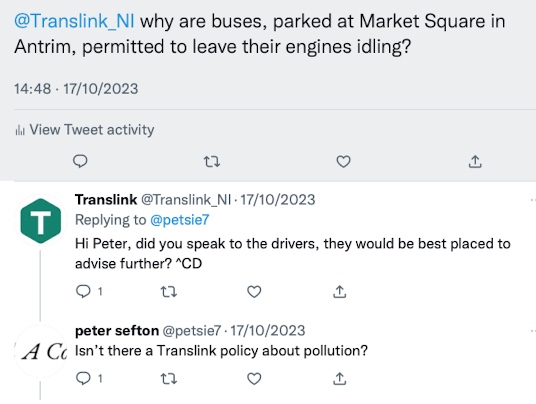
Being interested in why busses sat with their engines idling, I contacted Translink, first through X/Twitter.
This was the reply:
I thought it not a good idea to board a bus and challenge the driver, so interaction continued.
This is what happened next:
Dear Mr Sefton
Thank you for your email.
We do have a whistleblowing policy in place however this is an internal document and available to Translink staff members only.
You can request a copy of this as a freedom of information request to foi@translink.co.uk, however this kind of information is never guaranteed.
I hope that this helps you.
Yours sincerely,
Jonathan Customer Services Department Adelaide Depot Building B 8 Falcon Road Belfast, BT12 6PU 02890 666630 option 3
I pointed out that I was not a whistle blower, then this:
Good afternoon Peter,
Thank you for being in touch and I am sorry to learn of the incident that occurred.
Further to your comments, I can confirm that the information you have provided has been logged in accordance with Translink’s Complaint Handling Policy, and will be retained for the attention of Ulsterbus for feedback purposes.
Should you wish us to investigate further, however, we will require more detailed information to include route number, reg (if possible), time and date of the incident/s .Please respond by return, ensuring that you include as much detail as possible in relation to the incident that took place.
Please be advised, for the protection of both our staff and customers, all our public service vehicles are equipped with CCTV. Incidents of this nature will have been recorded and can be downloaded and retained for the purposes of investigation.
Thank you again for taking the time to bring this to our attention, and for giving us the opportunity to investigate and put things right.
Going forward, I wish you well and sincerely hope you will not be deterred from using our services in the future.
Kind regards
Aaron
Being convinced that Aaron was a bot, I replied:
Dear Aaron
Thank you for your reply, sent this morning but with the salutation “good afternoon”.
This might be a clue that you are in fact, a robot.
The enquiry which I made related to pollution caused by stationary busses leaving their engines idling at Market Square Antrim. No incident occurred as you have suggested.
Perhaps you would pass the correspondence to a human being, for an answer.
Peter Sefton
I tried again:
Dear Aaron
I fear I have not made my question clear.
Is there a general instruction that busses, stopped at a terminal , should not sit with their engines idling?
Can I make my point any better?
Peter
Aaron leapt into action:
Good morning Peter,
Can you please advise of any route numbers of these services so I can forward to the relevant depot (they could be from a number of depots) to investigate and take necessary action. The registration of buses is also very helpful if available.
Thank you for this.
Kind regards
Aaron
Enter “Assistant Service Delivery Manager”
Hi Peter
Thank you for contacting Translink.
If buses are stopping at any point for any length of time the driver is expected to switch off the engine as excess idling is not permitted. The newer fleet that has arrived in Antrim over the last 18 months are fitted with an automatic switch off which activates when the bus stops and the door is opened.
Furthermore, our drivers go through refresher courses each year and they are reminded of this policy.
If at any time you come across a bus that is sitting idling I would welcome the details, i.e. Fleet or Reg No and time of incident, as the driver can then be challenged on this.
Once again thank you for bringing this matter to my attention.
Best regards
Enda Sheridan
Assistant Service Delivery Manager
Ulsterbus Antrim/Ballymena/Larne
Assuming that Enda knew what he was talking about, I was reassured that Translink had a robust policy, forbidding idling. Furthermore, new technology would render idling otiose. I enthusiastically entered into touting on drivers and provided details of several.
Then this bombshell from the “TCSA”:
Dear Peter,
Thank you for your recent feedback regarding bus PEZ 7281 idling, please accept our apologies.
Drivers are permitted to leave an engine running in colder months to heat their bus, but I have notified the depot responsible for the bus of your feedback.
Translink’s policies on Environmental issues is available on our website.
Translink are very grateful you have brought this to our attention, allowing us the opportunity to respond and apologise, correct errors on our part, and look at ways we can improve our service to you.
Gerald So the on the new busses the engines don’t stop when the doors open, as stated by your colleague? I had expected your excuse about the cold weather. The odd thing is that the passengers are usually dressed in warm clothes, since they have been outdoors. Perhaps it’s to warm the driver. I look forward to the pollution free and silent summer months in Market Square. Peter
I searched for the Translink environmental policy. Here it is:
Climate change is the most pressing environmental challenge of our time, with overwhelming scientific evidence that we need to act now. The scale of the challenge demands a step change in both the breadth and scale of ambition, and we all have a duty to act quickly and decisively to reduce emissions. For Translink, transport has a huge role to play in the economy reaching Net Zero.
Achieve at least a 50% reduction in our current emissions by 2030 in line with our Climate Action Pledge
Place Translink at the forefront in the journeytowards zero emission public transportation, and for all our buses, trains, and buildings to be Net Zero by 2040.
Be Climate Positive by 2050, going beyond achieving net zero to create an environmental benefit by removing additional carbon dioxide from the environment while growing our business.
To achieve these aims, a climate positive philosophy will be applied across the whole range of Translink’s operations. This includes the transport fleet, buildings, estate, and all associated aspects.
Having an aspirational Climate Positive Strategy will help us further improve our local air quality, keep the population active and moving for a healthier region, and help rebuild our economy to be fit for a low emissions future.
Our Climate Positive Strategy provides a measured, coordinated approach to achieve our targets, with a framework of priority objectives and high-level actions across all three of our Go Eco work-streams (Energy and Carbon, Biodiversity, and Resource Efficiency).
Planning for a future without fossil fuels
Translink is already planning for the day we stop buying fossil fuels. We have purchased 100% renewable electricity since 2020. Over 100 of our fleet of 1,400 buses are already zero-emissions and we have over 100 more on order. In 2023 Foyle will become the first city in the UK or Ireland to have a zero-emission public transport service. Our support fleet is already substantially electrically driven, and we continue to plan for delivery of a higher capacity but zero-emission railway during the 2030s.
Translink’s project teams are currently embedding an understanding and evaluation of the carbon impacts within our infrastructure and engineering works. Many projects are re-using materials on site, on other Translink projects, or in partnership with local communities, schools, or wider environmental programmes.
Our infrastructure and land provide a huge opportunity to help reach our targets, by offsetting residual emissions where we don’t yet have the technology to do so, through planting trees and carbon sequestration. Our land may also provide opportunities for renewable energy generation.
Let’s Change Together
As part of our #LetsChangeTogether campaign, we have produced a Climate Change Animation detailing plans and targets to be Climate Positive by 2050 and acting as a call to action for others to join us in making sustainable changes.
Achieving Climate Positive
The ‘Translink SPIRIT’ is a set of guiding principles that are a fundamental part of everything we do. These core values are embedded in the culture of the organisation and enable us to lead, inspire, and succeed in delivering our goals for Translink. To achieve our targets, our values of Safety, People, Innovation, Responsibility, Integrity, and Teamwork hold strong. By following these principles, we can develop and deliver viable, credible, behavioural, and technical climate positive actions.
As you would be aware , Dear Reader, there are people who are paid handsomely to produce that drivel.
All the buzz words are there, I’ve highlighted them for you.
The same themes are present in Translink as in the Housing Executive , PPS PSNI , local councils, NI Assembly etc etc.
They are :
Get someone to write buzz words
Publicise them, virtue signalling
Ignore them internally
Talk nonsense to any member of the public that might ask a question
Continue on their own merry way and pocket the salary
As Translink boldly goes towards Climate Positive by 2050, busses are still idling, to keep the driver warm.
It’s twenty years since I first took active steps to try and find the killers of my parents.
A Crown prosecutor for many years, it was slowly dawning on me that what I had been told, professionally, was not what it seemed in many cases.
I started gently, asking for an update on the killings, which had happened twelve years earlier. It might surprise the reader to know that in those twelve years , not one officer in charge had ever contacted me with an update.
My first enquiries were met with the usual obfuscation and it took many months before I had an intelligent response.
That was to tell me almost nothing.
Where was the file? Well, it was clear that it had been put away many years before and no detective had given it a second thought in those years.
What followed was a succession of promises from lots of senior officers who , shortly afterwards retired.
I will not trouble you Dear Reader, with the HET or the Police Ombudsman, because my target is elsewhere.
Follow the money
The Patten payment scheme, ostensibly designed to remove sufficient officers to achieve some parity of religious breakdown in the police, was a bonanza to members of the RUC.
A fifty year old superintendent with thirty years enhanced pensionable service could expect a lump sum of £300,000 and an annual pension of £27,000.
A constable in similar circumstances could expect a lump sum of £134,000 and an annual sum of £13,000.
There were other benefits too. Money to train to be a mountain guide in the Mournes, for example.
Four thousand officers took the Patten offer.
Then there were revised injury on duty schemes.
Then there was a hearing loss scheme.
All-in-all the State paid out more than half a billion pounds to ex-RUC officers.
What did it get in return?
The absolute unwavering silence of every member of the RUC about any information relating to wrongdoing by its members, even if it resulted in the death of a colleague.
For the State, the mirror image is the menu of on-the-runs, Royal Pardons and huge sums paid to SFIRA.
In the last twenty years a number of police officers, known to me personally, and for whom, on occasions I had given advice, pro bono; could have given me information, evidence, a hint, a ‘steer’ or a nod, about the circumstances of the killing of one of their own [and his wife].
Apart from one seriously unwell detective, not one of these heroes opened their mouths.
Let me give you an example, Dear Reader.
Alan Simpson was the senior CID officer in D Division on the day of the bomb, 6th June 1990. I met him, I think , that day or the next. I certainly met him at the inquests, because he was managing them.
Years on, an intermediary, who I had helped, suggested that Simpson might be willing to meet me and discuss the case. A date was set , I awaited his arrival but was told instead that he was too ill to meet me.
I suggested that, if I could communicate by email, that would suffice.
He provided his email.
I wrote to him.
On 7/23/20, peter sefton wrote:
“Alan
Thank you for providing your email address. My parents were murdered by PIRA by a PIRA ucbt on the Ballygomartin Road on the morning of 6 June 1990. I think that you were in Tennent St at the time, in charge of CID. I seem to recall that we met, once at least, at the inquest. On the day of their deaths or the next day, I was in Tennent St and I was taken to a room and shown a wall display of the suspected bomb team, including their photographs. I believe one may have been a woman and another was a Finucane. I have been campaigning for justice for them, actively, since 2002 and very pro-actively , since 2014. I know that a person called Braniff was arrested and questioned shortly after the deaths but was released without charge. My question is : As CID commander, did you receive intel from the Branch or any other entity, including a CHIS , as to the identity of the culprits? Were any suspects protected by the Branch, FRU/Army or MI5? My hypothesis is that PIRA were so infiltrated by the State that, even if advance knowledge was not available [though I have reservations about that scenario] identities would have been ascertained in the aftermath. So it is a matter of great distress to me that no prosecution ensued. Time for me is short and I would like to unlock this case sooner rather than later.
Regards
Peter Sefton”
Within 24 hours he replied:
“Hello Peter,
Thank you for your email.
My desk is almost clear now and I will be in touch probably over the weekend.
Best…..
Alan.”
He never did reply. Big desk.
My intermediary was apologetic but assured me that Simpson was ‘very unwell’.
I heard no more from Simpson but was mildly interested that he wrote to the Times on the deaths of Lords Hutton and Kerr, suggesting that he had met them in the course of his duties. Then he published an article in the Belfast Telegraph on 19th January this year. I don’t subscribe to this rag and the article, behind the paywall began:
Colleagues fed me a false line on Finucane killing writes Alan Simpson
“As a former RUC CID Detective Superintendent, I was greatly disappointed, but not surprised, at the Police Ombudsman’s recent finding that there had been “collusive behaviours” by elements of Special Branch when dealing with UDA killer gangs in the north-west of the province.”
Perhaps he has a ghost writer or he has risen Lazarus- like from his bed or perhaps his solicitor , Kevin Winters, has inspired him to write about Finucane but not Jimmy Sefton.
Let me be clear, in the course of my career I met many brave, devoted and honest police officers.
I also met rogues, cowards and liars, the latter too often in the course of a trial.
My observations are directed at those whose help I have sought, directly or indirectly, who have been motivated by one thing.
Money
I could name these men. But, aside from the most egregious, Alan Simpson, I won’t.
What lesson can we learn?
The State has bought their compliance and silence.
The operation to kill Jimmy Sefton, happily retired but not on Patten, aged 65 and by implication, his wife, wasn’t sketched out on the back of a fag packet. It was scouted, planned , approved at the highest levels in PIRA. It is inconceivable that informers, agents, touts, whatever you want to call them, were not involved. It is inconceivable that Special Branch did not have information and that some or all of that was not shared with CID.
Without exaggeration, it is likely that a dozen RUC officers have information that would be useful to their case.
The same silence operated against my parents is practised when investigations into other killings are carried out by other bodies.
Some of these culprits think nothing of instructing solicitors on their own behalf and for their own cases who are , shall we say, critical of the State.
This blog is written more in sorrow than in anger. I saw enough in my time of corruption at the highest levels of the RUC. Often it was at the expense of their junior colleagues and of justice; but killing is in another realm.
The fact remains that “one of their own” will receive no justice because money talks.
Many of the men of whom I speak profess Christianity.


 seftonblog