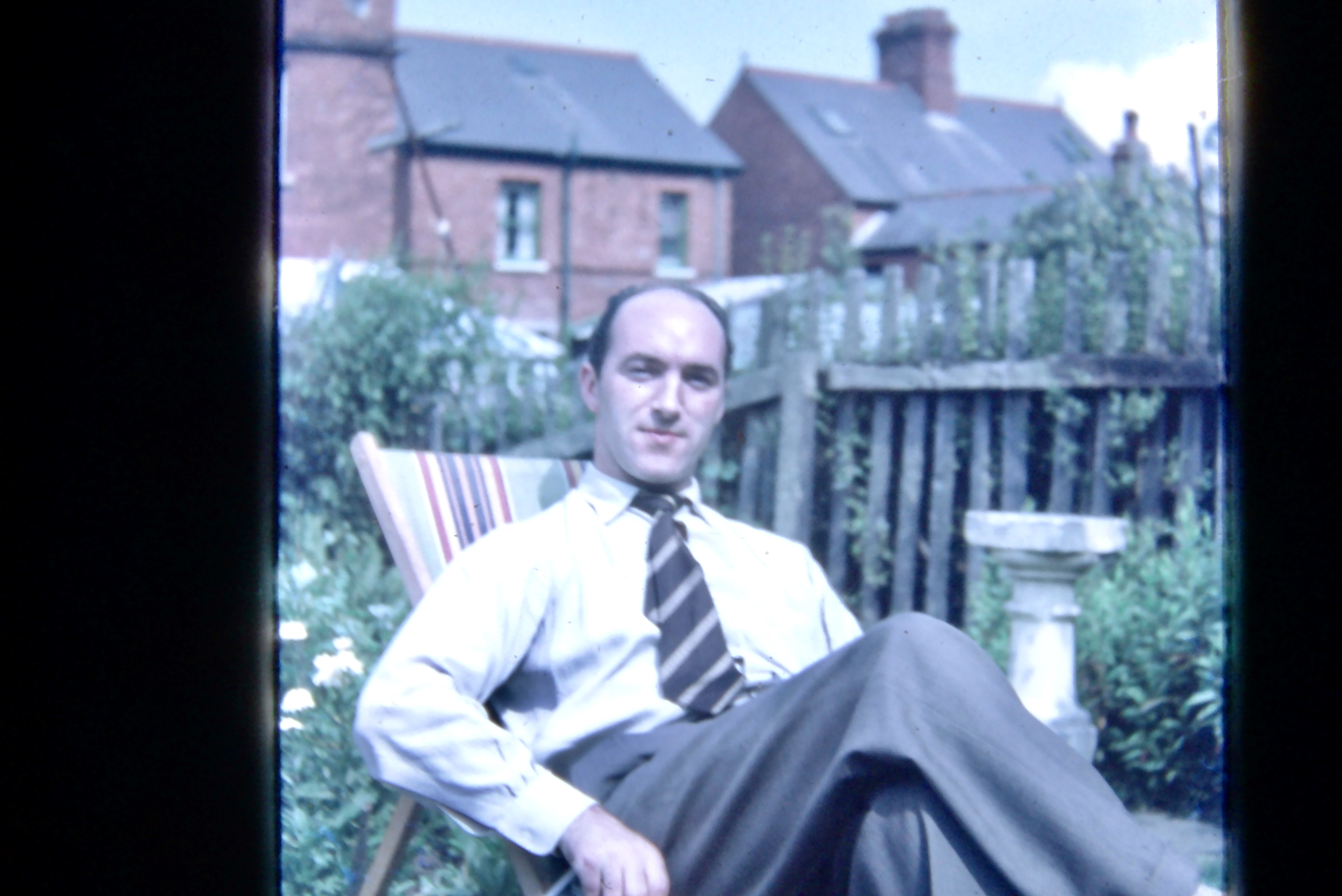
25th February 1925 – 6th June 1990
Jimmy is 100 today.
He’ll be sitting in his favourite armchair, still complaining about the inaccuracy of the BBC weather forecast and nestling a glass of whiskey, with which one was greeted in the winter months.
He’ll be reminiscing about his days in the force. How they were once pinned down by a sniper and had to run across a wide street, one-by-one to escape. Or when their lives were saved by an informer who rang in to say there was an ambush ahead.
Or maybe he’ll be talking cars. From the sixties he was a Ford man, turning to the Japanese later and then to his final car, a Proton, from Malaysia. My early choice of a white XR3i was deemed a “young con’s car”. A clean car was essential. “Yours looks like a Provo staff car”.
Or travel. His favourite place was Venice and his favourite bar, Harry’s.
I imagined it to be a flashy emporium. I visited it last year. It sits just off the Grand Canal. Small and unimposing from the outside, it is understated; the waiters are beautifully mannered and impeccably dressed. No shorts or jeans permitted after six. I could see why he liked it so much.
James was born on 25th February 1925 on a cold day with rain turning to sleet; to William and Cissie [nee Annette] both of Huguenot descent. He lived his early years with his parents, brother and sister in a small house off the Shankill road in Belfast.
On his sixteenth birthday he was apprenticed to Harland and Wolff, serving his time and working for many subsequent years in the Engine Works. He later moved to Standard Telephones and Cables as a supervisor, before joining the RUC. He served in the Home Guard while an apprentice and seems to have enjoyed the training, especially the thunder flashes. He made me a beautifully crafted half size Thompson machine gun, which was the envy of my boys’ gang, they equipped with toy shop revolvers. We spent many hours constructing Airfix planes and ships. He was an excellent artist and later turned his talents to photography. I watched as he patiently saved to buy his first 35mm camera, moving on later to a range of Pentax.
Jimmy worked “all God’s hours” in the shipyard, in the “Standard” and in the force. My abiding memory is of him leaving for a night shift during the loyalist protest at the signing of the Anglo-Irish agreement. I expressed concern for his safety, which he dismissed, even when I said I would buy fire extinguishers for the house.
Books were his passion. He read at least three a week, borrowed from the Shankill Road library. When I was eight, he took me there and signed me up. He took me to a shelf in the Children’s section and selected Dicken’s Tale of two Cities. “I think you’ll like this”. I took it home and opened it:
“It was the best of times, it was the worst of times.”
Thus started my love of books and of learning and of libraries, Shankill, Queens and the Bar.
He and my mother were what would be called today ‘aspirational parents’ Though when I got a place at Queens and announced it over breakfast, his response was “anyone who gets a place at university and fails to make the most of it, should be shot”.
A smoker until his forties, his treat at Christmas was a Tom Thumb cigar.
He had a short retirement, frequently travelling to warm places with my mother.
A few days after his death, a postcard from their holiday in Tenerife arrived, it said: “having a beer in the shade, the Germans haven’t the wit to get out of the midday sun”.
To the last, laconic, quiet and universally described by his colleagues as a gentleman.
“But I have promises to keep,
And miles to go before I sleep,
And miles to go before I sleep.”
 seftonblog